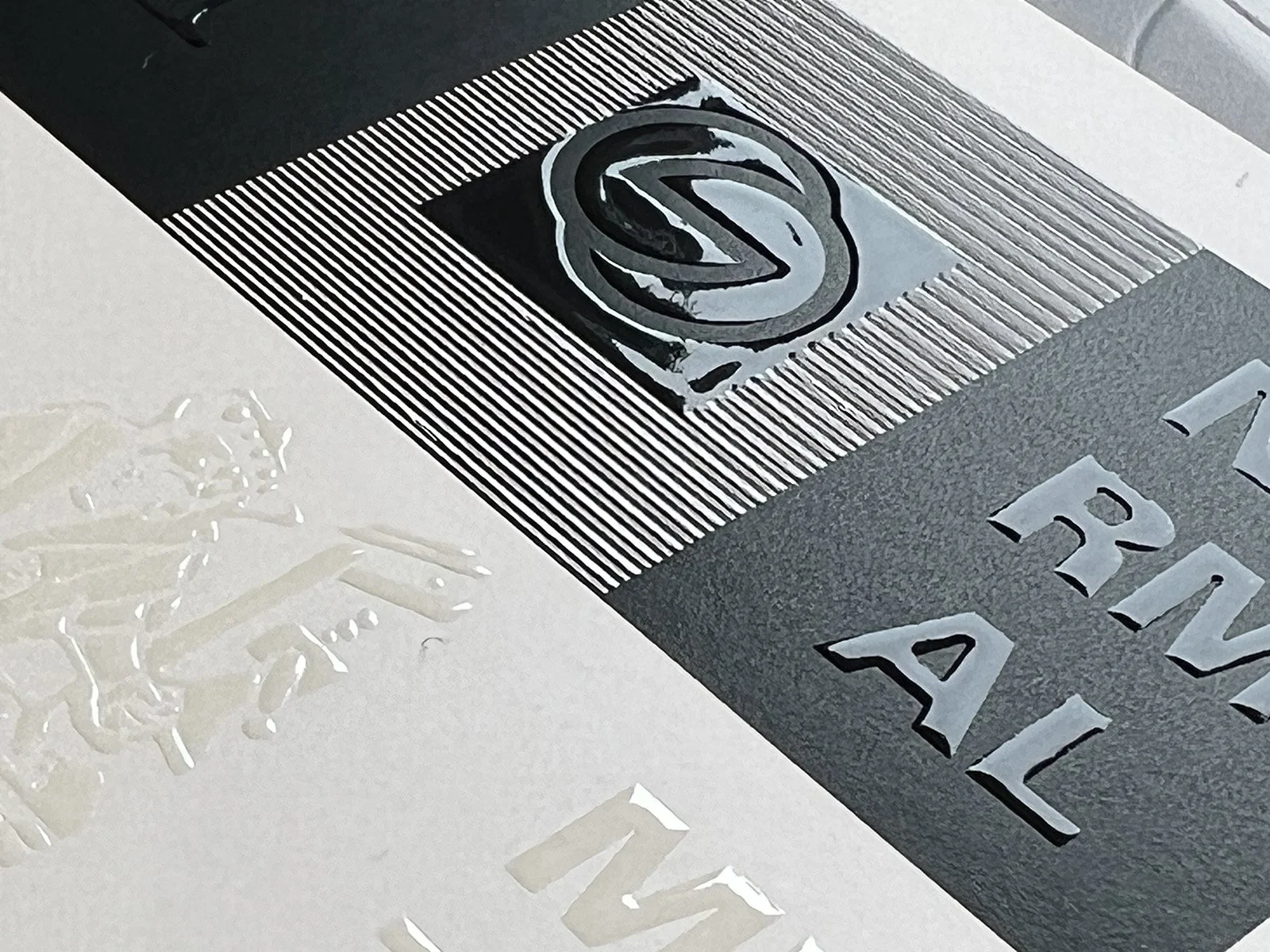
UV-Spotlackierung
im Detail
photos/samples: forum-druckveredelung // g.a.s // KURZ
-
Die Spotlackierung ist eine punktuelle Veredelungstechnik, bei der bestimmte Bild- oder Textelemente selektiv mit Lack beschichtet werden. Ziel ist es neben funktionalen Aspekten, optische oder haptische Akzente zu setzen und ausgewählte Bereiche gleichzeitig zu schützen. Besonders in Kombination mit matten oder ungestrichenen Papieren entsteht durch glänzende Spotlacke ein markanter Kontrast, der Aufmerksamkeit erzeugt und das Druckprodukt hochwertiger erscheinen lässt.
Typische Anwendungen sind Logos, Headlines, grafische Elemente oder Bilddetails, die durch Glanz hervorgehoben oder durch spezielle Lacke fühlbar gemacht werden. Lacke vereinen immer sowohl visuelle, als auch funktionale Aspekte, z. B. Kratzbeständigkeit. Die wichtigsten Vertreter ihrer Gattung sind:
Glanzlacke: damit werden Bildbereiche optisch hervorgehoben
Relieflacke: werden relativ dick aufgetragen, wirken optisch und haptisch, z. B. Braille-Schriften
Softtouch-Lacke: werden dünn aufgetragen und bieten eine samtig-gummiartige Oberfläche
Strukturlacke: entwickeln aufgrund ihrer Formulierung Oberflächenstrukturen, die z. B. an Sandpapier erinnern
Pigmentlacke: enthalten winzige reflektierende oder lichtbrechende Stoffe, die irisierende optische Wirkungen entfalten
Darüber hinaus gibt es noch eine ganze Reihe von Speziallacken wie z. B.: Tagesleuchtfarben, Nachleuchtfarben, Thermochromfarben, Rubbelfarben, Duftfarben, Wet&View Farben etc.
Manche Lacke können inline direkt im Druckprozess eingesetzt werden oder sie werden offline in einem separaten Arbeitsgang aufgetragen. Hochwertige Ergebnisse erzielt man unter anderem im UV-Offsetdruck, UV-Flexodruck, Siebdruck oder Digitaldruck. Je nach Verfahren lassen sich unterschiedliche Effekte und Lackdicken realisieren – von dezenten Glanzakzenten bis zu fühlbaren Strukturen.
Ein zentraler Faktor ist der Bedruckstoff: Je nach Oberfläche, Saugfähigkeit und Struktur muss der passende Lacktyp gewählt werden. Auf sehr rauen Papieren kann ein dünner Lackauftrag optisch verloren gehen, während glänzende Papiere weniger Kontrast zu Spotlackierungen bieten.
Technisch gilt: Präzision hat ihre Grenzen. Besonders bei offline durchgeführter Lackierung solltest du mit Registertoleranzen von etwa 0,3 bis 0,5 mm rechnen. Sehr feine Linien oder kleinteilige Typografie sind daher kritisch – sowohl optisch als auch hinsichtlich der Positionierung. Spotlackierungen entfalten ihre Wirkung am besten auf größeren Flächen oder klar abgegrenzten Elementen, wo der Kontrast zwischen lackierten und unlackierten Bereichen stärker wahrgenommen wird.
Spotlackierung ist damit ein vielseitiges Mittel, um Druckprodukte gezielt zu veredeln – vorausgesetzt, Gestaltung, Materialwahl und Technik sind gut aufeinander abgestimmt.
-
Spot varnishing is a selective finishing technique in which specific image or text elements are selectively coated with varnish. In addition to functional considerations, the aim is to create visual or tactile highlights whilst simultaneously protecting selected areas. Particularly when used in combination with matt or uncoated papers, glossy spot varnishes create a striking contrast that attracts attention and makes the printed product appear of higher quality.
Typical applications include logos, headlines, graphic elements or image details that are highlighted by gloss or made tactile through the use of special varnishes. Varnishes always combine both visual and functional aspects, such as scratch resistance. The most important types are:
Gloss varnishes: these are used to visually highlight areas of an image
Embossed varnishes: these are applied relatively thickly and have both a visual and tactile effect, e.g. Braille text
Soft-touch varnishes: applied thinly, they provide a velvety, rubber-like surface
Textured varnishes: due to their formulation, they create surface textures reminiscent of, for example, sandpaper
Pigment varnishes: contain tiny reflective or light-refracting particles that produce iridescent optical effects
In addition, there is a whole range of speciality varnishes, such as: daylight-fluorescent inks, afterglow inks, thermochromic inks, scratch-off inks, scented inks, Wet&View inks, etc.
Some varnishes can be applied inline directly during the printing process, whilst others are applied offline in a separate operation. High-quality results can be achieved using, amongst other methods, UV offset printing, UV flexographic printing, screen printing or digital printing. Depending on the process, different effects and varnish thicknesses can be achieved – ranging from subtle glossy accents to tactile textures.
A key factor is the substrate: the appropriate type of varnish must be selected depending on the surface, absorbency and texture. On very rough papers, a thin coat of varnish may be visually lost, whilst glossy papers offer less contrast to spot varnishing.
Technically speaking: precision has its limits. Particularly with offline varnishing, you should expect registration tolerances of around 0.3 to 0.5 mm. Very fine lines or small-scale typography are therefore critical – both visually and in terms of positioning. Spot varnishing is most effective on larger areas or clearly defined elements, where the contrast between varnished and unvarnished areas is more pronounced.
Spot varnishing is therefore a versatile means of selectively enhancing printed products – provided that the design, choice of material and technique are well coordinated.
-
Le vernissage sélectif est une technique de finition ponctuelle qui consiste à recouvrir de manière sélective certains éléments graphiques ou textuels d’un vernis. Outre les aspects fonctionnels, l’objectif est d’apporter une touche esthétique ou tactile tout en protégeant les zones sélectionnées. C’est notamment en combinaison avec des papiers mats ou non couchés que les vernis sélectifs brillants créent un contraste saisissant qui attire l’attention et confère au produit imprimé un aspect plus haut de gamme.
Les applications typiques sont les logos, les titres, les éléments graphiques ou les détails d’images qui sont mis en valeur par la brillance ou rendus perceptibles au toucher grâce à des vernis spéciaux. Les vernis allient toujours des aspects à la fois visuels et fonctionnels, comme la résistance aux rayures. Les principaux représentants de cette catégorie sont :
Vernis brillants : ils permettent de mettre en valeur visuellement certaines zones de l’image
Vernis en relief : appliqués en couche relativement épaisse, ils produisent un effet visuel et tactile, par exemple pour l’écriture en braille
Vernis « soft-touch » : ils sont appliqués en couche fine et offrent une surface veloutée et caoutchouteuse
Vernis texturés : grâce à leur formulation, ils créent des textures de surface qui rappellent, par exemple, le papier de verre
Vernis pigmentés : ils contiennent de minuscules particules réfléchissantes ou réfractantes qui produisent des effets optiques irisés
Il existe en outre toute une série de vernis spéciaux, tels que : les encres fluorescentes, les encres phosphorescentes, les encres thermochromiques, les encres à gratter, les encres parfumées, les encres « Wet&View », etc.
Certains vernis peuvent être utilisés en ligne, directement au cours du processus d’impression, ou bien ils sont appliqués hors ligne lors d’une étape distincte. On obtient des résultats de haute qualité notamment en impression offset UV, en flexographie UV, en sérigraphie ou en impression numérique. Selon le procédé, il est possible de réaliser différents effets et différentes épaisseurs de vernis – allant de subtiles touches brillantes à des textures perceptibles au toucher.
Le support d’impression est un facteur essentiel : il faut choisir le type de vernis adapté en fonction de la surface, de la porosité et de la structure. Sur des papiers très rugueux, une fine couche de vernis peut passer inaperçue visuellement, tandis que les papiers brillants offrent moins de contraste avec les vernissages sélectifs.
D’un point de vue technique : La précision a ses limites. En particulier pour les vernissages réalisés hors ligne, il faut s’attendre à des tolérances de repérage d’environ 0,3 à 0,5 mm. Les lignes très fines ou les caractères de petite taille sont donc critiques, tant sur le plan visuel qu’en termes de positionnement. Les vernissages sélectifs produisent leur meilleur effet sur de grandes surfaces ou des éléments clairement délimités, où le contraste entre les zones vernies et non vernies est plus fortement perçu.
Le vernis sélectif est donc un moyen polyvalent d’embellir de manière ciblée les produits imprimés – à condition que la conception, le choix des matériaux et la technique soient bien coordonnés.