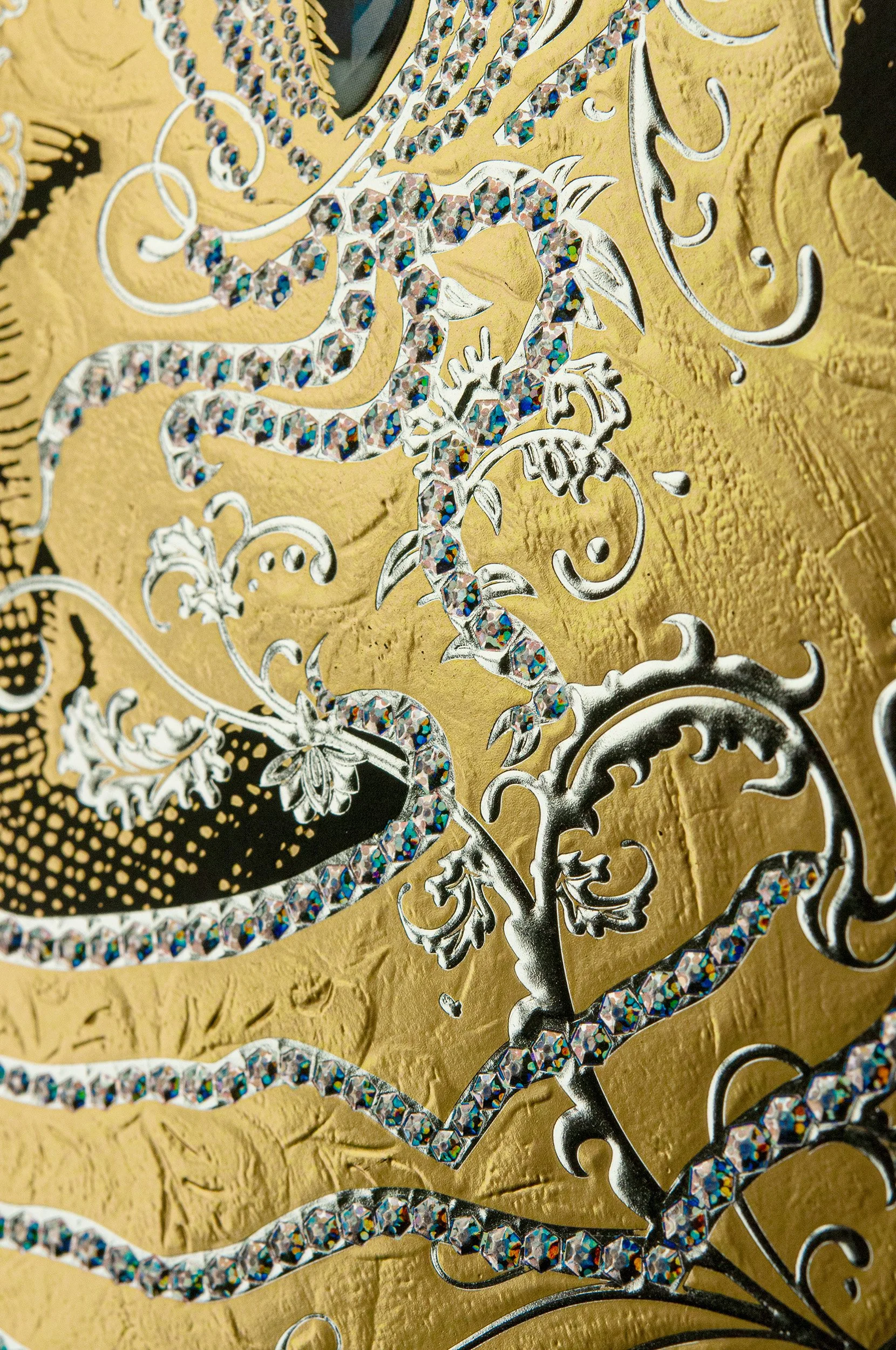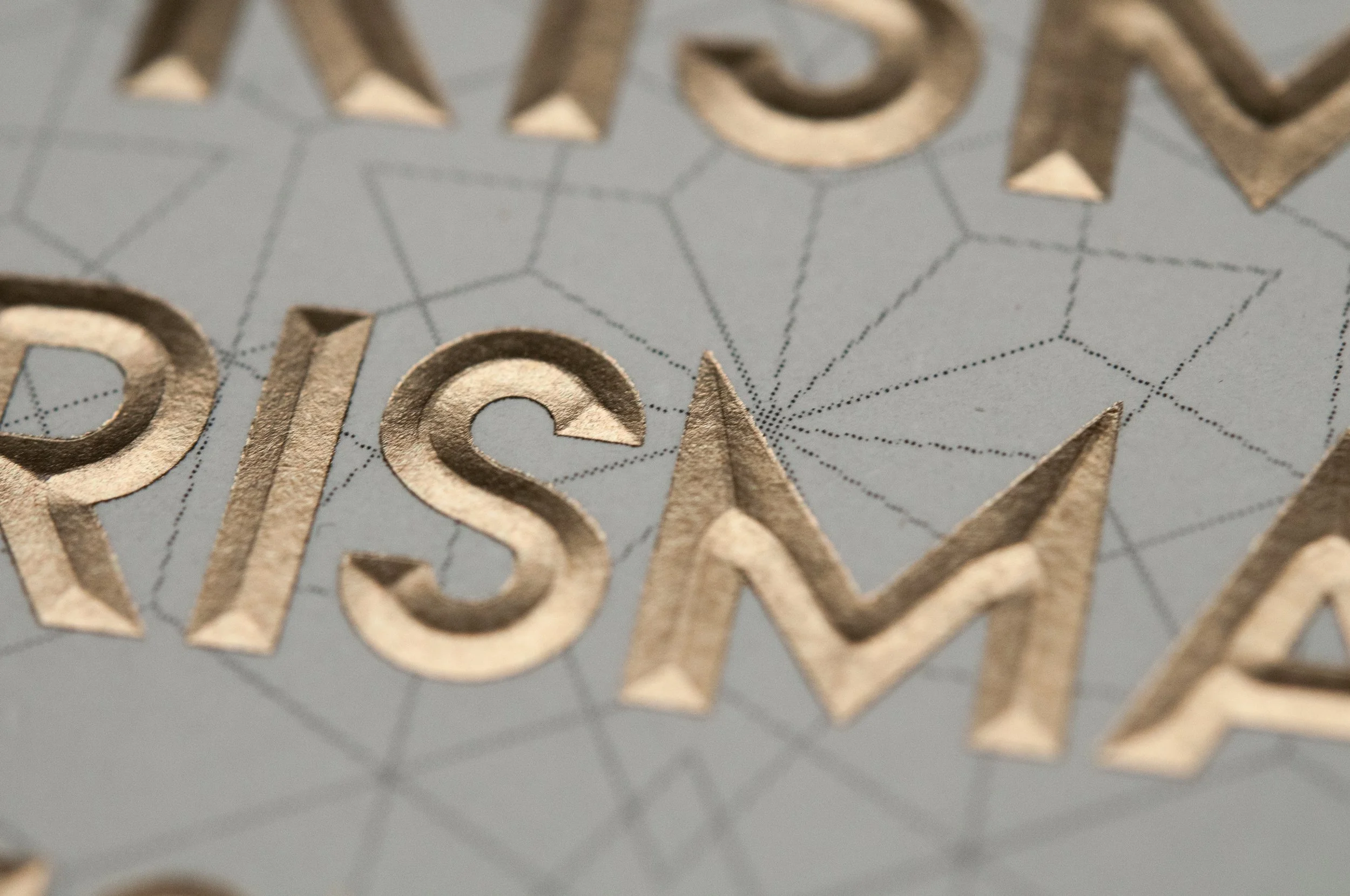
Heißprägung im Detail
photos/samples: forum-druckveredelung // g.a.s // KURZ
-
Auch bekannt als:
Reliefprägung, Heißfolienprägung mit ReliefBei der Heißprägung mit Reliefschnitt wird nicht nur eine Metallisierung aufgebracht, sondern gleichzeitig eine dreidimensionale Struktur ins Material geprägt. So entsteht eine Kombination aus Glanz und Haptik – metallisch veredelt und fühlbar erhaben oder vertieft.
Je nach gewünschtem Effekt kommen unterschiedliche Reliefkonturen zum Einsatz:
– Raised Round, Flat oder Roof für erhabene Prägungen mit runder, flacher oder spitz zulaufender Form
– Debossed Round, Flat oder Roof für vertiefte Varianten derselben Konturen
Für komplexere Motive bieten Multi-Level-Prägungen mehrere Höhenstufen und ermöglichen fließende Übergänge oder gestaffelte Ebenen.
Besonders raffiniert wird es in Kombination mit Micro- oder Nanoembossing: Feinstrukturen werden direkt in das Relief eingebracht – ideal für grafische Muster und Texturen, Sicherheitsmerkmale oder, um außergewöhnliche Lichtreflexe zu erzeugen.
Diese Technik erfordert eine präzise Abstimmung von Gestaltung, Werkzeug und Material – bietet dafür aber maximale gestalterische Tiefe und Differenzierung.
Zu beachten:
Als Relief bezeichnet man eine Materialverformung, deren deren Formgrenzen bestimmte Geometrien aufweisen. Für Reliefprägungen muss in der Regel immer auch eine Gegeform (Patritze) zusammen mit dem Prägewerkzeug hergestellt werden. Dazu muss dem Gravurbetrieb sowohl die Prägemaschine als auch die Materialstärke bekannt sein.
Für die Heißprägung mit Relief muss das Prägemotiv eine gewisse Breite bzw Strichstärke bei Linien und Schriften aufweisen, damit ein Relief realisierbar ist.Werkzeugdaten:
Es werden Vektordaten benötigt, die man als Volltonfarbe auf einer eigenen Ebene anlegen sollte. Die Pfade dürfen nicht verdeckt sein oder überlappen. Konturen müssen geschlossen und Schriften in Pfade umgewandelt sein.Das Druckbild unter der Heißprägung wird in der Regel nicht ausgespart. Bei Druckbildern mit hohem Gesamtfarbauftrag und großen Prägeflächen, kann man das Druckbild aus der Prägung aussparen, um Gassing zu vermeiden. Die Prägekontur sollte dabei mindesten 0,5 mm überdrucken, um Blitzer zu vermeiden.
Bedruckstoff:
Die Heißprägung eignet sich zur Veredelung von gestrichenen und ungestrichenen Papieren sowie folienkaschierten Materialien. Auch auf hochflorigen, beflockten und textilen Oberflächen lässt sich dieses Verfahren anwenden, wobei zuvor getestet werden sollte, ob das Dekor ausreichend haftet. Für lackierte Oberflächen gibt es spezielle Transferfolien, und andererseits gibt es auch spezielle für Heißprägung geeignete Lacke. Die Auswahl der passenden Transferfolie für einen bestimmten Bedruckstoff sollte sorgfältig mit dem Hersteller abgestimmt werden. -
Hot stamping with a relief die not only applies a metallic finish but also embosses a three-dimensional texture into the material at the same time. This creates a combination of shine and tactile quality – a metallic finish that is noticeably raised or recessed to the touch.
Depending on the desired effect, different relief contours are used:
– Raised Round, Flat or Roof for raised embossing with a round, flat or tapered shape
– Debossed Round, Flat or Roof for recessed versions of the same contours
For more complex designs, multi-level embossing offers several height levels and enables smooth transitions or staggered planes.
The effect becomes particularly sophisticated when combined with micro- or nano-embossing: fine structures are incorporated directly into the relief – ideal for graphic patterns and textures, security features or to create extraordinary light reflections.
This technique requires precise coordination of design, tooling and material – but in return offers maximum creative depth and differentiation.
Please note: Relief refers to a deformation of the material whose contours exhibit specific geometries. For relief embossing, a counter-mould (patrix) must generally always be produced alongside the embossing die. To achieve this, the engraving company must be aware of both the embossing machine and the material thickness.
For hot stamping with relief, the stamping motif must have a certain width or line thickness for lines and text so that a relief effect can be achieved.
Die data: Vector data is required, which should be created as a solid colour on a separate layer. The paths must not be obscured or overlap. Outlines must be closed and text must be converted to paths.
The printed image beneath the hot foil stamping is not usually excluded from the stamping area. For printed images with high overall ink coverage and large stamping areas, the printed image can be excluded from the stamping area to prevent ink bleeding. The stamping outline should extend at least 0.5 mm beyond the printed image to prevent flash marks.
Substrate: Hot stamping is suitable for finishing coated and uncoated papers as well as film-laminated materials. This process can also be applied to high-pile, flocked and textile surfaces, although tests should be carried out beforehand to ensure the design adheres sufficiently. Special transfer foils are available for varnished surfaces, whilst there are also special varnishes suitable for hot stamping. The selection of the appropriate transfer foil for a specific substrate should be carefully coordinated with the manufacturer.
The printed image expands slightly due to the contact pressure of the embossing die, which must be taken into account particularly with delicate motifs, narrow typefaces, negative lettering or small font sizes. Lines can be embossed down to a minimum thickness of around 0.3 pt, although this also depends on the nature of the substrate.
Depending on the embossing pressure and the material of the substrate, the contour of the die can range from barely visible to clearly embossed. On thinner materials in particular, the embossing may show through to the reverse side.
-
Le marquage à chaud avec une gravure en relief permet non seulement d’appliquer une métallisation, mais aussi d’imprimer simultanément une structure tridimensionnelle dans le matériau. Il en résulte une combinaison de brillance et de texture : une finition métallique avec des reliefs ou des creux perceptibles au toucher.
Selon l’effet souhaité, différents contours en relief sont utilisés :
– Raised Round, Flat ou Roof pour des gaufrages en relief de forme arrondie, plate ou effilée
– Debossed Round, Flat ou Roof pour les variantes en creux des mêmes contours
Pour les motifs plus complexes, les gaufrages à plusieurs niveaux offrent plusieurs degrés de hauteur et permettent des transitions fluides ou des niveaux échelonnés.
Le résultat est particulièrement raffiné lorsqu’on y associe le micro- ou le nano-gaufrage : des structures fines sont directement intégrées au relief – idéal pour les motifs graphiques et les textures, les éléments de sécurité ou pour créer des reflets de lumière exceptionnels.
Cette technique nécessite une coordination précise entre le design, l’outil et le matériau – mais offre en contrepartie une profondeur créative et une différenciation maximales.
À noter : On appelle « relief » une déformation du matériau dont les contours présentent des géométries définies. Pour les gaufrages en relief, il faut en règle générale toujours fabriquer une contre-forme (matrice) en même temps que l’outil de gaufrage. Pour cela, l’entreprise de gravure doit connaître à la fois la machine de gaufrage et l’épaisseur du matériau.
Pour le gaufrage à chaud avec relief, le motif à gaufrer doit présenter une certaine largeur ou épaisseur de trait au niveau des lignes et des textes afin qu’un relief soit réalisable.
Données relatives à l’outil : Des données vectorielles sont nécessaires ; celles-ci doivent être créées en couleur unie sur un calque distinct. Les tracés ne doivent pas être masqués ni se chevaucher. Les contours doivent être fermés et les textes convertis en tracés.
En règle générale, l’image imprimée sous le marquage à chaud n’est pas évidée. Pour les images imprimées présentant une forte densité d’encre et de grandes surfaces de marquage, il est possible d’évider l’image imprimée du marquage afin d’éviter la formation de bulles d’air. Le contour du marquage doit alors dépasser l’image imprimée d’au moins 0,5 mm pour éviter les reflets.
Support d’impression : Le gaufrage à chaud convient à la finition des papiers couchés et non couchés ainsi que des matériaux contrecollés avec un film. Ce procédé peut également être appliqué sur des surfaces à poils longs, floquées et textiles, mais il convient de vérifier au préalable si le décor adhère suffisamment. Il existe des films de transfert spéciaux pour les surfaces vernies, ainsi que des vernis spécialement adaptés au gaufrage à chaud. Le choix du film de transfert adapté à un support d’impression donné doit être soigneusement coordonné avec le fabricant.
L’image imprimée s’étire légèrement sous l’effet de la pression exercée par le poinçon de gaufrage, ce dont il faut tenir compte en particulier pour les motifs filigranes, les polices étroites, les polices en négatif ou les petites tailles de caractères. Les lignes peuvent être gaufrées jusqu’à une épaisseur minimale d’environ 0,3 pt, bien que cela dépende également de la nature du support d’impression.
En fonction de la pression de gaufrage et du matériau du support d’impression, le contour du cliché peut être gaufré de manière à peine visible ou très marquée. Sur les matériaux plus fins notamment, le gaufrage peut apparaître au verso.