Hologrammprägung im Detail
photos/samples: forum-druckveredelung // g.a.s // KURZ
-
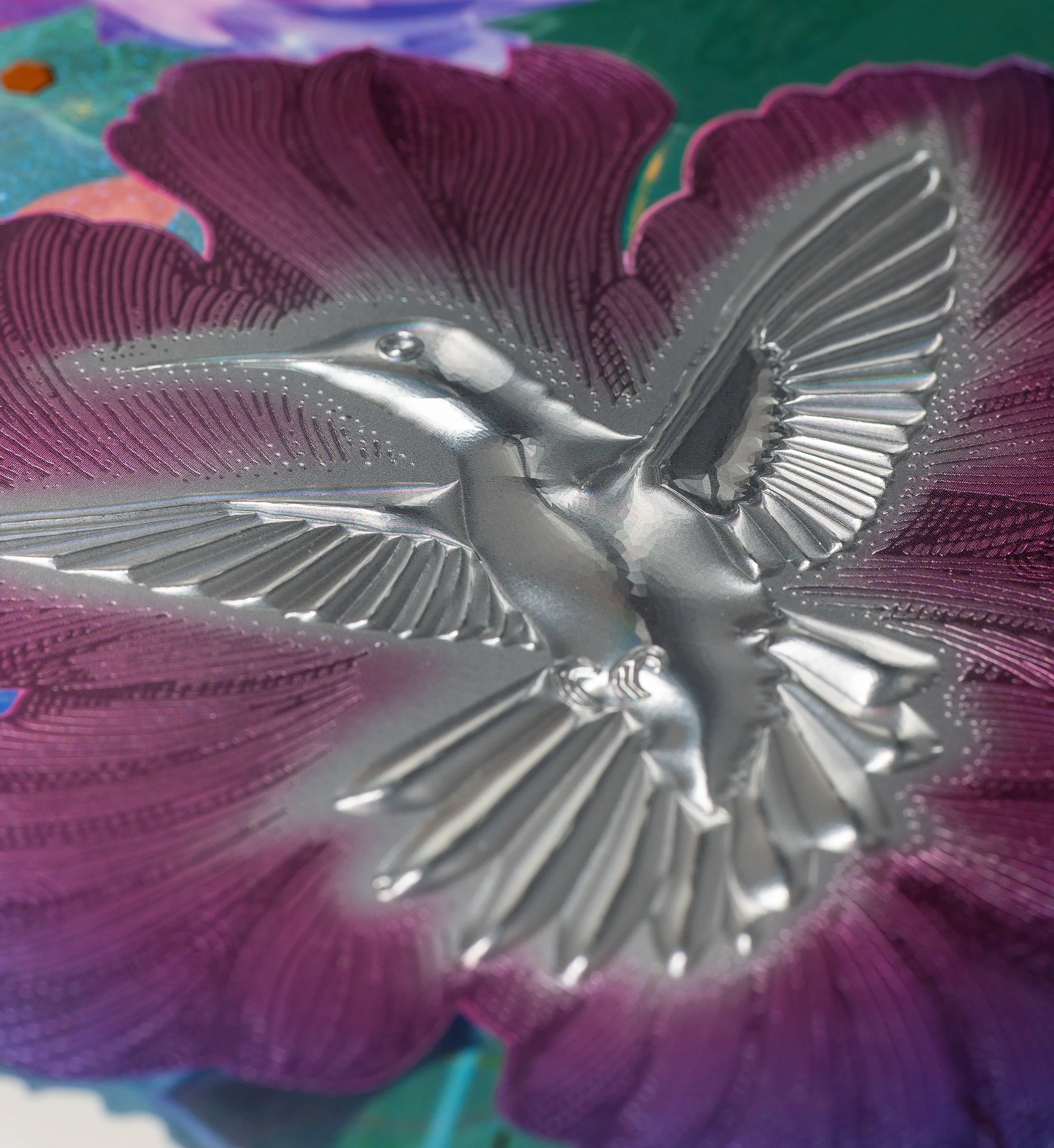
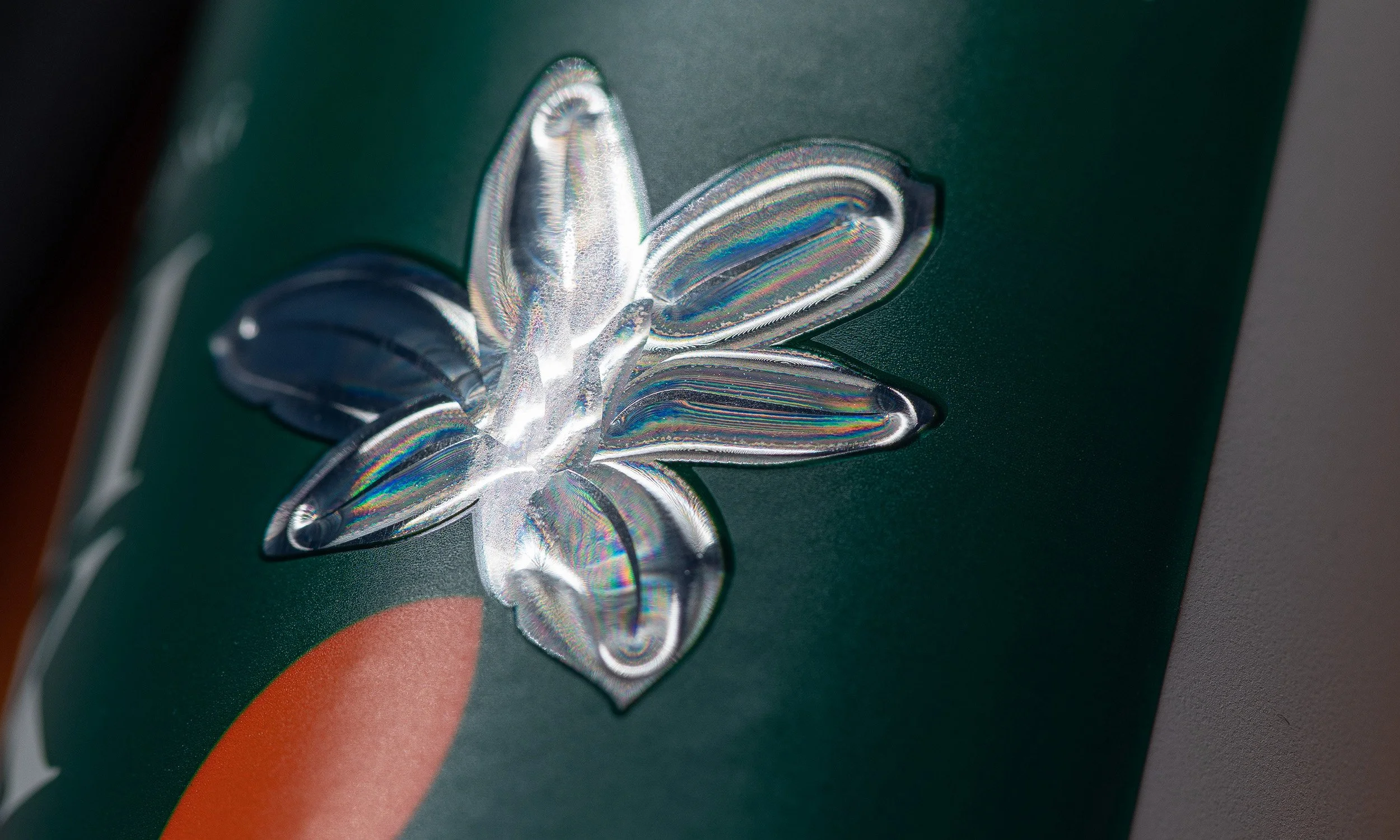
Hologrammprägungen zählen zu den technisch wie optisch anspruchsvollsten Formen der Druckveredelung. Sie entstehen durch die strukturierte Oberflächengestaltung der metallisierten Dekorschicht, die im Heißprägeverfahren auf das Substrat übertragen wird (siehe Anmerkung*). Dabei werden feinste Mikro- oder Nanostrukturen so angeordnet, dass sie das Licht auf komplexe Weise brechen. Je nach Betrachtungswinkel entsteht ein faszinierendes Spiel aus Farben, Tiefe und Bewegung.
Unterschieden wird zwischen Endloshologrammen (z. B. sich wiederholende Muster oder Linien) und sogenannten Einzelbildhologrammen, bei denen ein spezifisches Bildmotiv präzise positioniert werden muss. Während Endlosdekore mit jeder gängigen Heißprägemaschine appliziert werden können, erfordert die Applikation von Einzelbildhologrammen eine Prägemaschine mit Registriereinheit.
Diese Einheit erkennt Registermarken auf der Prägefolie und sorgt dafür, dass das Hologramm exakt an der vorgesehenen Stelle positioniert wird.
Hologrammprägungen sind weit mehr als nur ein optischer Effekt: Je nach Ausführung dienen sie auch als Fälschungsschutz – z. B. auf Tickets, Ausweisen oder hochwertigen Verpackungen. Der Sicherheitsgrad variiert stark, je nachdem, ob es sich um ein Standardhologramm oder ein individuell gestaltetes Sicherheitsmerkmal handelt und welche sicherheitsrelevanten Komponenten verwendet wurden.
In HInblick auf Recycling gelten die gleichen Bedingungen wie für klassische Heißprägungen, sie beeinflussen sie den Recyclingprozess der Druckprodukte in keiner Weise negativ.
Die Herstellung solcher Hologramme ist technologisch aufwendig und erfordert spezielle Masterstrukturen, die meist in Reinraumumgebungen erzeugt werden.
Hologramme sind also nicht nur eindrucksvolle Designelemente, sondern bieten auch funktionalen Mehrwert – vorausgesetzt, Gestaltung, Maschinen-Setup und Sicherheitsbedürfnisse sind gut aufeinander abgestimmt.
Anmerkung:
Interessant ist, dass es für die Etikettenherstellung auf speziellen Rollendrucksystemen die Möglichkeit gibt, Hologramme im Kalttransfer zu applizieren. Die Firma Leonhard KURZ bietet mit dem DISTORUN® Modul ein System an, das in Kombination mit einem Flexodruckwerk, holografische Einzelbilder präzise auf Etikenntenmaterial übertragen kann.Zu beachten:
Manche Dekore haben eine optische Ausrichtung, die Effekte laufen beispielsweise horizontal bzw vertikal. Man muss daher die Laufrichtung mit der Druckerei klären, damit der Effekt anschließend auch wie gewünscht erscheint. -
Holographic embossing is one of the most technically and visually sophisticated forms of print finishing. It is created by the structured surface design of the metallised decorative layer, which is transferred to the substrate using a hot-foil stamping process (see note*). In this process, extremely fine micro- or nanostructures are arranged in such a way that they refract light in complex ways. Depending on the viewing angle, this creates a fascinating interplay of colours, depth and movement.
A distinction is made between continuous holograms (e.g. repeating patterns or lines) and so-called single-image holograms, where a specific image motif must be precisely positioned. Whilst continuous-pattern holograms can be applied using any standard hot-foil stamping machine, the application of single-image holograms requires a stamping machine fitted with a registration unit.
This unit detects registration marks on the holographic foil and ensures that the hologram is positioned exactly where intended.
Hologram embossing is far more than just a visual effect: depending on the design, it also serves as a counterfeit-proofing measure – for example, on tickets, ID cards or high-quality packaging. The level of security varies greatly depending on whether it is a standard hologram or a customised security feature, and on which security-related components have been used.
As far as recycling is concerned, the same conditions apply as for conventional hot foil stamping; they do not adversely affect the recycling process of the printed products in any way.
The production of such holograms is technologically complex and requires special master structures, which are usually produced in cleanroom environments.
Holograms are therefore not only striking design elements but also offer functional added value – provided that the design, machine setup and security requirements are well coordinated.
Note: It is interesting to note that, for label production on specialised web-fed printing systems, it is possible to apply holograms using cold transfer. With the DISTORUN® module, Leonhard KURZ offers a system which, in combination with a flexographic printing unit, can precisely transfer individual holographic images onto label stock.
Please note: Some designs have a specific orientation, with effects running horizontally or vertically, for example. It is therefore necessary to clarify the direction of run with the print shop to ensure that the effect subsequently appears as desired.
-
Gaufrage holographique
Le gaufrage holographique compte parmi les techniques de finition d'impression les plus exigeantes, tant sur le plan technique qu'esthétique. Il résulte de la structure de la surface de la couche décorative métallisée, qui est transférée sur le support par un procédé de gaufrage à chaud (voir remarque*). Des microstructures ou nanostructures extrêmement fines sont disposées de manière à réfracter la lumière selon un principe complexe. Selon l’angle d’observation, il en résulte un jeu fascinant de couleurs, de profondeur et de mouvement.
On distingue les hologrammes en continu (par exemple, des motifs ou des lignes répétitifs) et ce que l’on appelle les hologrammes à image unique, pour lesquels un motif spécifique doit être positionné avec précision. Alors que les motifs en boucle peuvent être appliqués avec n’importe quelle machine de marquage à chaud courante, l’application d’hologrammes à image unique nécessite une machine de marquage équipée d’une unité de repérage.
Cette unité détecte les repères de positionnement sur la feuille de marquage et garantit que l’hologramme est positionné exactement à l’endroit prévu.
Les hologrammes estampés sont bien plus qu’un simple effet optique : selon leur conception, ils servent également de protection contre la contrefaçon – par exemple sur des billets, des pièces d’identité ou des emballages haut de gamme. Le niveau de sécurité varie considérablement selon qu’il s’agit d’un hologramme standard ou d’un élément de sécurité personnalisé, et selon les composants de sécurité utilisés.
En matière de recyclage, les conditions sont les mêmes que pour les estampages à chaud classiques ; ils n’ont aucune incidence négative sur le processus de recyclage des produits imprimés.
La fabrication de tels hologrammes est techniquement complexe et nécessite des structures maîtresses spécifiques, généralement produites en salle blanche.
Les hologrammes ne sont donc pas seulement des éléments de design impressionnants, mais offrent également une valeur ajoutée fonctionnelle – à condition que la conception, la configuration des machines et les besoins en matière de sécurité soient bien coordonnés.
Remarque : Il est intéressant de noter que, pour la fabrication d’étiquettes sur des systèmes d’impression à bobines spéciaux, il est possible d’appliquer des hologrammes par transfert à froid. Avec le module DISTORUN®, la société Leonhard KURZ propose un système qui, associé à une unité d’impression flexographique, permet de transférer avec précision des images holographiques individuelles sur le support d’étiquette.
À noter : Certains motifs présentent un alignement optique : les effets s’étendent par exemple horizontalement ou verticalement. Il est donc nécessaire de clarifier le sens de défilement avec l’imprimeur afin que l’effet apparaisse ensuite comme souhaité.