
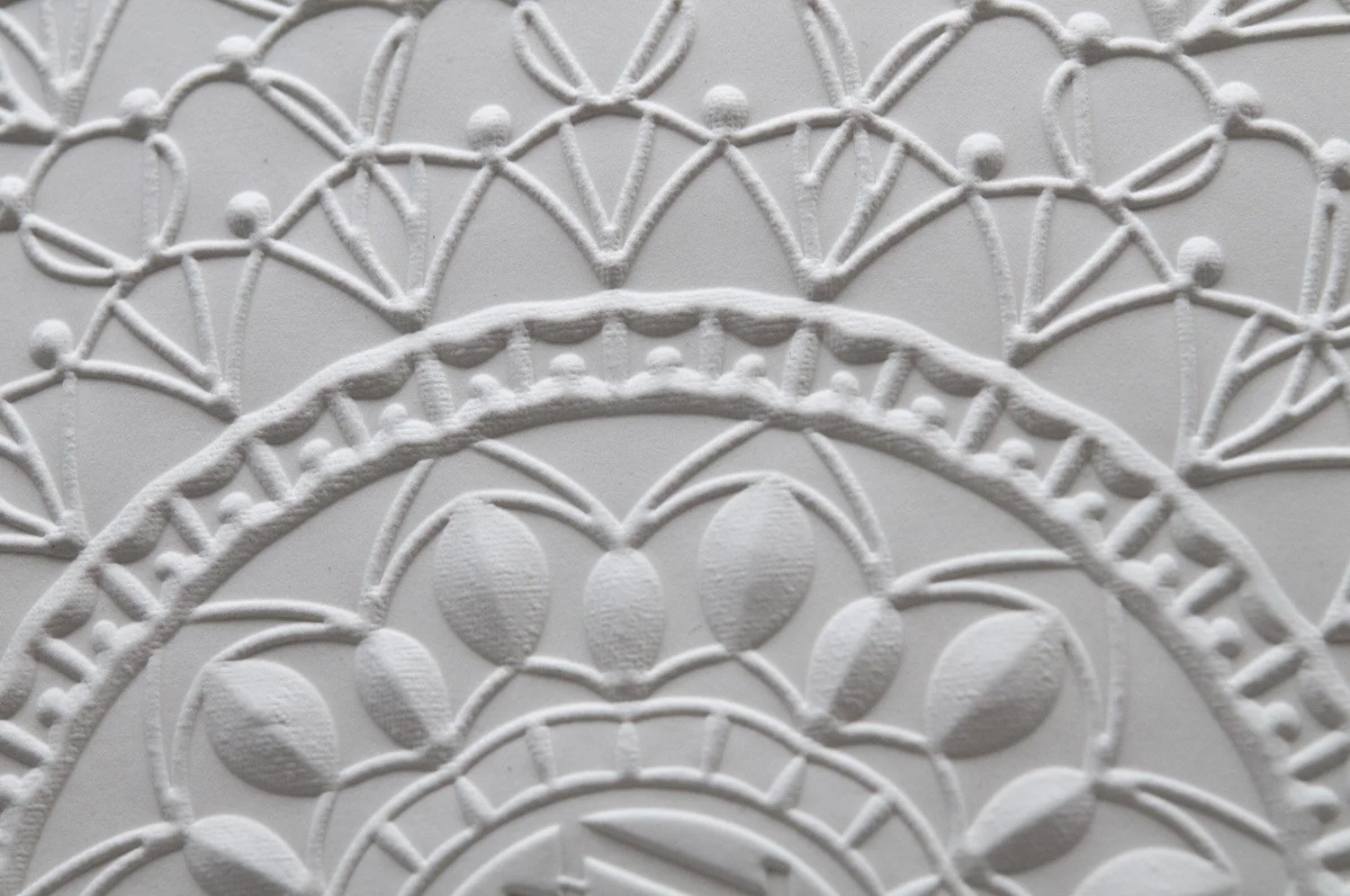
Heißprägung im Detail
photos/samples: forum-druckveredelung // g.a.s // KURZ
-
Auch bekannt als
Farblosprägung, Blinddruck, Reliefprägung, Prägedruck, BlindpressungDie Blindprägung ist ein rein mechanisches Veredelungsverfahren, bei dem der Bedruckstoff durch Druck plastisch verformt wird – ganz ohne Farb- oder Dekorschicht. Mithilfe eines Prägestempels und einer passgenauen Patrize entstehen erhabene oder vertiefte Elemente, die allein durch Licht und Schatten sichtbar werden.
Die Wirkung hängt stark von der Gestaltung der Prägestempel ab: Unterschiedlich steile Kanten, variierende Winkel und abgestufte Tiefen sorgen für mehr Prägnanz und Plastizität. Möglich sind einstufige, mehrstufige sowie skulpturierte Blindprägungen – also frei modellierte Formen mit organischem Verlauf. Auch feine Strukturen oder Texturen lassen sich prägen.
Wichtig: Die Verformung zeigt sich auch auf der Rückseite – bei dünnem Material deutlich, bei dickerem weniger. Dunkle oder unruhige Untergründe reduzieren oft die Licht-Schatten-Wirkung. Bei sehr feinen Motiven kann sich der Prägebereich durch den Druck leicht ausweiten, was bei der Gestaltung beachtet werden sollte.
Blindprägung ist ein stilles, aber starkes Gestaltungsmittel – präzise, hochwertig, haptisch und ganz ohne zusätzliche Stoffe.
Daten: Für eine einstufige Blindprägung müssen Vektordaten als Volltonfarbe vorbereitet sein, wobei klar zwischen kantigen oder runden Verformungen sowie Hoch- oder Tiefprägungen unterschieden wird. Pfade dürfen nicht verdeckt sein oder sich überlappen, und Konturen müssen geschlossen sein.
Bei einer mehrstufigen Blindprägung sind die Vektordaten für jede Prägeebene separat als Volltonfarbe oder als Graustufenbild mit mindestens 600 dpi zu erstellen, wobei die Graustufen unterschiedliche Höhen darstellen. Bei komplexen Motiven können zusätzliche Höhenangaben notwendig sein. Eine enge Abstimmung mit dem Klischeehersteller ist unbedingt ratsam.
Für skulpturierte Blindprägungen sollten Übergänge zwischen verschiedenen Höhen als Verläufe definiert werden. Die Vorlagen können selbst erstellt oder vom Werkzeughersteller gefertigt werden. Feinste Motive können durch eine Handgravur des Werkzeugherstellers verfeinert werden.
Ein Proof der Blindprägung ist als 3D-Rendering oder als Prägung auf dem Originalmaterial möglich.
-
Also known as
inkless embossing, blind embossing, relief embossing, relief stamping
Blind embossing is a purely mechanical finishing process in which the substrate is plastically deformed by pressure – without any ink or decorative layer whatsoever. Using an embossing die and a precisely fitted male die, raised or recessed elements are created which become visible solely through the interplay of light and shadow.
The effect depends heavily on the design of the embossing dies: edges of varying steepness, differing angles and graduated depths create greater distinctiveness and three-dimensionality. Single-stage, multi-stage and sculpted blind embossing are all possible – that is, freely modelled shapes with organic contours. Even fine structures or textures can be embossed.
Important: The embossing is also visible on the reverse side – clearly so on thin material, less so on thicker material. Dark or uneven backgrounds often reduce the light-and-shadow effect. With very fine motifs, the embossed area may expand slightly due to the pressure, which should be taken into account during the design process.
Blind embossing is a subtle yet powerful design tool – precise, high-quality, tactile and requiring no additional materials.
Data: For single-level blind embossing, vector data must be prepared as spot colours, with a clear distinction made between angular and rounded deformations, as well as raised and recessed embossing. Paths must not be obscured or overlap, and contours must be closed.
For multi-level blind embossing, the vector data for each embossing level must be created separately as a spot colour or as a greyscale image with a minimum resolution of 600 dpi, with the greyscale levels representing different heights. For complex designs, additional height specifications may be necessary. Close consultation with the die manufacturer is strongly recommended.
For sculpted blind embossing, transitions between different heights should be defined as gradients. The templates can be created in-house or produced by the die manufacturer. The finest designs can be refined by hand engraving carried out by the die manufacturer.
A proof of the blind embossing is available as a 3D rendering or as an embossed sample on the original material.
-
Également connu sous les noms de
gaufrage sans encre, impression en relief, gaufrage, impression en relief, estampage à sec
Le gaufrage à sec est un procédé de finition purement mécanique dans lequel le support d'impression est déformé plastiquement sous l'effet de la pression, sans aucune couche d'encre ni de décor. À l'aide d'un poinçon et d'une matrice parfaitement ajustée, on obtient des éléments en relief ou en creux qui ne deviennent visibles que par le jeu de la lumière et des ombres.
L’effet dépend fortement de la conception des poinçons : des arêtes plus ou moins raides, des angles variables et des profondeurs échelonnées confèrent davantage de relief et de plasticité. Il est possible de réaliser des gaufrages à froid à un seul niveau, à plusieurs niveaux ou sculptés – c’est-à-dire des formes librement modelées aux contours organiques. Même les structures ou textures fines peuvent être gaufrées.
Important : la déformation est également visible au verso – de manière nette sur les matériaux fins, moins sur les matériaux plus épais. Les supports sombres ou irréguliers réduisent souvent l’effet d’ombre et de lumière. Pour les motifs très fins, la zone de gaufrage peut légèrement s’étendre sous l’effet de la pression, ce dont il convient de tenir compte lors de la conception.
Le gaufrage à sec est un outil de conception discret mais puissant : précis, haut de gamme, tactile et ne nécessitant aucun matériau supplémentaire.
Données : pour un gaufrage à sec à un niveau, les données vectorielles doivent être préparées en couleur pleine, en distinguant clairement les déformations angulaires ou arrondies ainsi que les gaufrages en relief ou en creux. Les tracés ne doivent pas être masqués ni se chevaucher, et les contours doivent être fermés.
Dans le cas d’un gaufrage à sec à plusieurs niveaux, les données vectorielles doivent être créées séparément pour chaque niveau de gaufrage, sous forme de couleur unie ou d’image en niveaux de gris d’au moins 600 dpi, les niveaux de gris représentant différentes hauteurs. Pour les motifs complexes, des indications supplémentaires concernant les hauteurs peuvent s’avérer nécessaires. Une coordination étroite avec le fabricant de clichés est vivement recommandée.
Pour les gaufrages en relief sculptés, les transitions entre les différentes hauteurs doivent être définies sous forme de dégradés. Les modèles peuvent être créés par vos soins ou réalisés par le fabricant de l'outil. Les motifs les plus fins peuvent être affinés par une gravure à la main effectuée par le fabricant de l'outil.
Une épreuve du gaufrage en relief est possible sous forme de rendu 3D ou de gaufrage sur le matériau d'origine.
